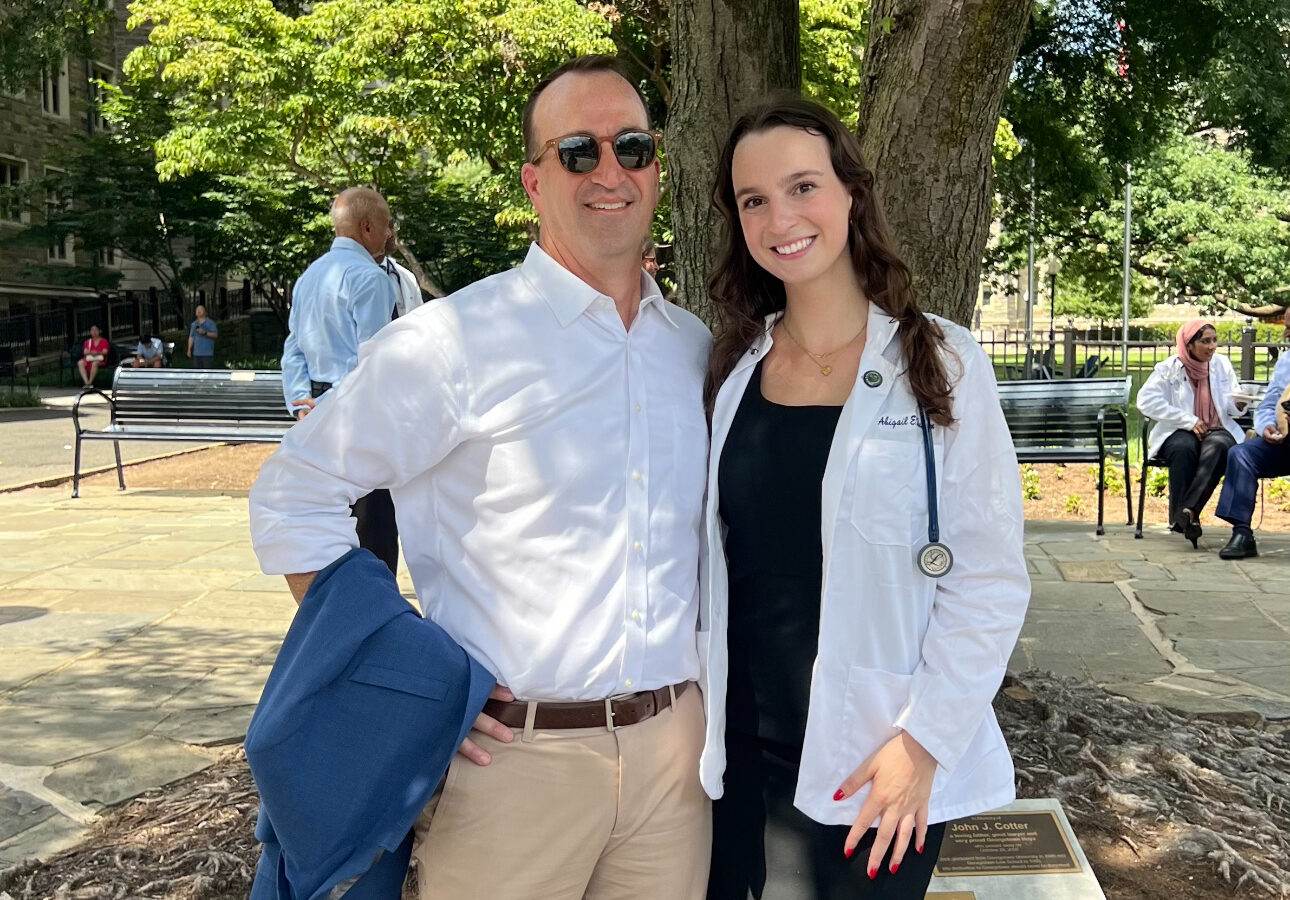
BellRinger Fellow Abigail Shuman grew up in the heart of Atlanta, just around the corner from Emory University, with two younger sisters and a natural inclination toward care. Her childhood dreams didn’t begin with medicine—they began with children. Inspired by her affinity for working with kids, Abigail set her sights on pediatrics early on, even before she fully considered becoming a doctor. That clarity of purpose, combined with a drive to understand the systems behind care, has shaped her journey into medical school and now into pediatric cancer research.

She attended the University of North Carolina at Chapel Hill for her undergraduate studies, majoring in Health Policy and Management at the Gillings School of Global Public Health, ranked among the top public health schools in the nation. Though she didn’t focus on hard sciences during undergrad, Abigail believes a deep understanding of the healthcare system will be essential for her future in medicine. That foundation served her well when she pursued the Special Master’s Program (SMP) in biophysics and physiology at Georgetown University, a rigorous curriculum that mirrors much of the M1 medical school experience. It gave her the confidence to take the next step: Georgetown University School of Medicine.
“Georgetown was a no-brainer,” Abigail says. “It’s a smaller, collaborative environment with a community that really emphasizes the art of medicine and cura personalis, care for the whole person.”
As a 2025 Mitchell BellRinger Oncology Research Fellow, Abigail spent her summer investigating stress as a potential risk factor for the development of neuroblastoma in children. Neuroblastoma is a pediatric cancer affecting our youngest patients, developing in utero and most often diagnosed before age 5. It arises from premature sympathetic neurons, the same “stress nerves” responsible for the stress response in adulthood. Abigail’s research addresses a critical gap in the field: prevention.
Most pediatric cancer research focuses on genetic factors, but genetics alone doesn’t explain who develops neuroblastoma or how severe it becomes. She was excited to explore how stress may interact with or enhance existing genetic predispositions. Specifically, her project focuses on understanding how paternal chronic stress prior to conception could alter the sperm’s epigenetic makeup, particularly in the non-coding RNA, and influence placental development. Poor placental development may lead to hypoxia (low oxygen) in utero, disrupting the differentiation of sympathetic neurons and ultimately increasing the risk of neuroblastoma.
This interdisciplinary project, led by Georgetown’s Dr. Joanna Kitlinska, assistant professor of biochemistry and molecular & cellular biology, and Dr. Sonia de Assis, associate professor of oncology, bridges neuroscience, oncology, and reproductive health. Abigail’s work contributes to an ongoing study that already found an increased neuroblastoma incidence in male offspring of chronically stressed fathers. Her role involves studying the placenta from these models to identify potential anatomical or nutrient-based disruptions that might explain this discrepancy.
 Having never worked in a wet lab before, Abigail found herself immersed in a new side of science, conducting lab experiments under a fume hood and applying knowledge from her first year of medical school to a real-world investigation. “It’s been eye-opening,” she reflects. “The timing was perfect. I’ve already studied embryology and physiology, so this experience has helped me connect those lessons to actual research.”
For Abigail, participating in BellRinger brings her experience full circle. This will be her first year involved, and she’s still deciding whether to ride or volunteer. Either way, she’s eager to be a part of something that builds community around the very research she’s contributing to. “It’s exciting to be more active—not just in the science of it all, but in the awareness and advocacy pieces as well,” she says.
She’s also struck by how much BellRinger celebrates survivorship and life. “In pediatric medicine, you see both great loss and incredible wins. Events like BellRinger are the highs—the moments when you get to celebrate progress and community.”
For Abigail, who hopes to pursue a career in neonatology, this fellowship has not only deepened her scientific understanding but also reaffirmed her commitment to care that begins even before birth. It’s a fitting start for someone whose dream was never simply to become a doctor, but to support children and their families through their most vulnerable moments.
The Mitchell BellRinger Oncology Research Fellowship Program, named in honor of Georgetown University School of Medicine Dean Emeritus Stephen Ray Mitchell, MD, recognizes his extraordinary contributions to advancing medical student research during his tenure as Dean for Medical Education at Georgetown. Established in 2024 with support from the family of Elena and Barney Byrd, the program is now additionally funded by Dr. Mitchell and his wife, Ellen, after being deeply moved by the recognition. Through the BellRinger Fellowship program, Georgetown Lombardi will continue to drive cancer research forward and mentor the next generation of researchers.