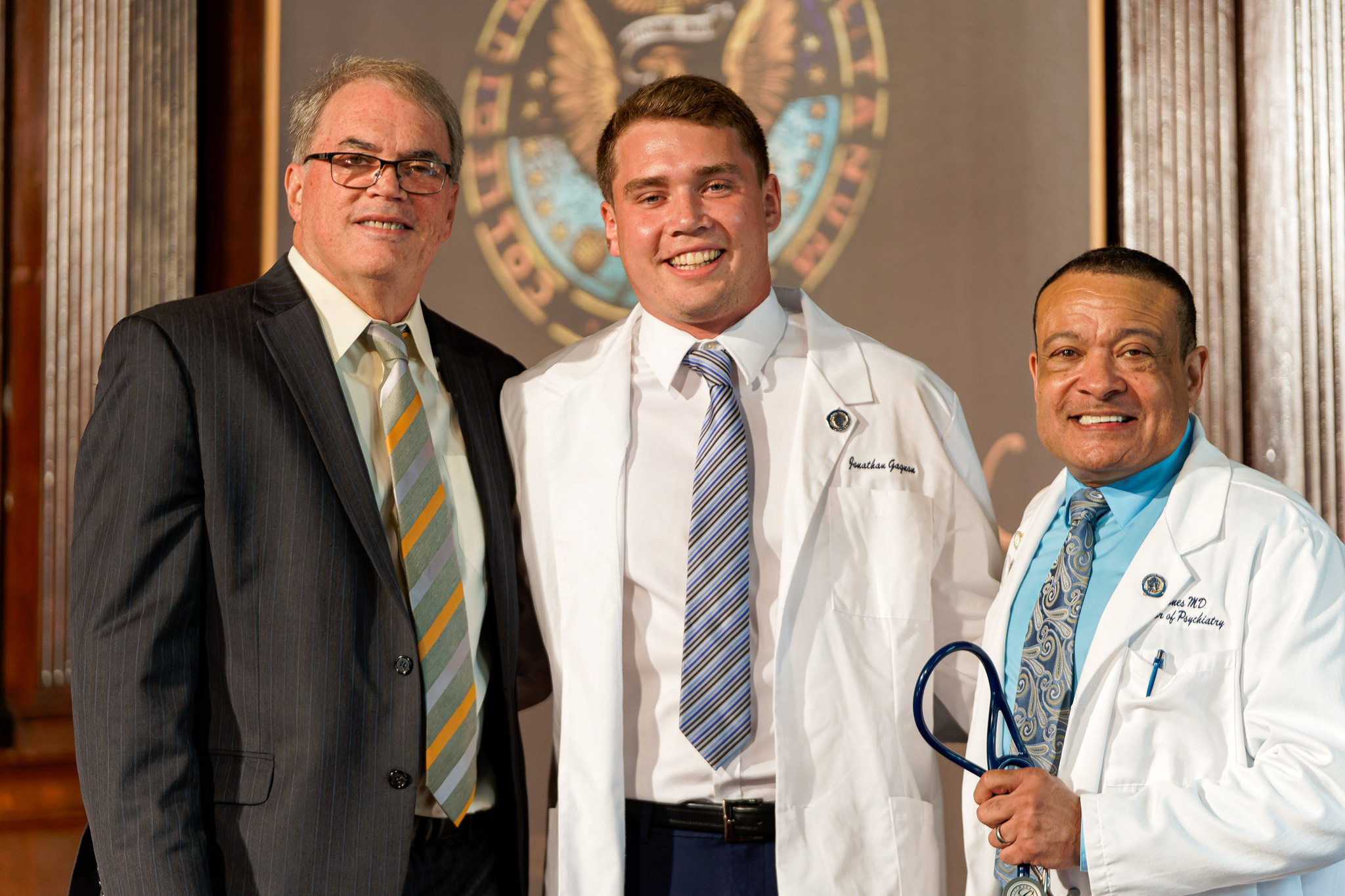
BellRinger Fellow Jonathan Gagnon’s story begins just outside Washington, D.C., in Potomac, Maryland, where his connection to Georgetown University was established before he could walk. He was born at MedStar Georgetown University Hospital and spent countless childhood hours visiting his father, now an oncologist, in the halls of the medical center. For most kids, a hospital might feel like an intimidating place. For Jonathan, it was the backdrop of early curiosity, inspiration, and comfort — a place where he first became familiar with the world of medicine and cancer care.
That early exposure took on a deeper meaning in 2023 when his oldest brother was diagnosed with lymphoma. Watching his brother undergo treatment at Georgetown’s Lombardi Comprehensive Cancer Center shaped Jonathan’s perspective on cancer and renewed his desire to pursue research that could make a tangible difference. “He’s doing well now,” Jonathan says, “but seeing the therapies he’s been able to access is a huge part of what drew me to this work.”
Jonathan attended Washington and Lee University, where he studied biochemistry and played on the football team. While his academic interests leaned heavily toward science, it was the combination of coursework and hands-on experiences that solidified his decision to pursue medicine. So when it came time for medical school, returning to Georgetown felt not just fitting, but personal.
This summer, as a Mitchell BellRinger Oncology Research Fellow, Jonathan has immersed himself in breast cancer research under the guidance of Dr. Christopher Albanese, professor of oncology and pathology and Dr. Barry Hudson. Jonathan’s project focuses on triple-negative breast cancer, a subtype known for its aggressive behavior and resistance to conventional chemotherapy. Jonathan’s work explores the RAGE signaling pathway, investigating whether certain drugs can be used to both enhance existing treatments and potentially prevent resistance from developing in the first place. The research is early-stage, requiring patience, repetition, and critical thinking as results unfold over time. For Jonathan, the process has been as impactful as the science.
“There’s a lot of growing cells, pipetting, running experiments that can take a week, and then you might have to do it again two more times to make it valid,” he explains. “It’s definitely been a learning curve, but working with the PhD students in the lab has been incredibly rewarding. They have such deep expertise, and it’s helped me better understand the clinical implications of the biology we’re studying.”
 While he doesn’t see a future for himself in a lab long-term, the experience has strengthened his desire to treat cancer, likely from the surgical side of medicine, and given him a stronger foundation for understanding the science behind patient care. “This kind of research is foundational,” he says. “Even if we don’t see the outcomes for years, it’s essential to keep pushing forward.”
Jonathan is also preparing to take on his first ride in BellRinger this October. He’s looking forward not just to the physical feat, but to the opportunity to meet and connect with others who are committed to ending cancer in their own ways.
“There are so many people who ride for deeply personal reasons, and I’m looking forward to hearing their stories,” he says. “Whatever path I end up taking, I think it’s important to understand how everyone—clinicians, researchers, fundraisers, survivors—plays a role in the fight against cancer. BellRinger brings all of those perspectives together.”
That belief in collective impact is what draws Jonathan to BellRinger’s mission, and to the power of community-driven philanthropy. “Cancer research is kind of like going down a hundred different doors hoping one of them opens,” he says. “You don’t get that one breakthrough without trying all the rest. Community support gives researchers the freedom to pursue those paths—and gives their work a chance to change lives.”
The Mitchell BellRinger Oncology Research Fellowship Program, named in honor of Georgetown University School of Medicine Dean Emeritus Stephen Ray Mitchell, MD, recognizes his extraordinary contributions to advancing medical student research during his tenure as Dean for Medical Education at Georgetown. Established in 2024 with support from the family of Elena and Barney Byrd, the program is now additionally funded by Dr. Mitchell and his wife, Ellen, after being deeply moved by the recognition. Through the BellRinger Fellowship program, Georgetown Lombardi will continue to drive cancer research forward and mentor the next generation of researchers.