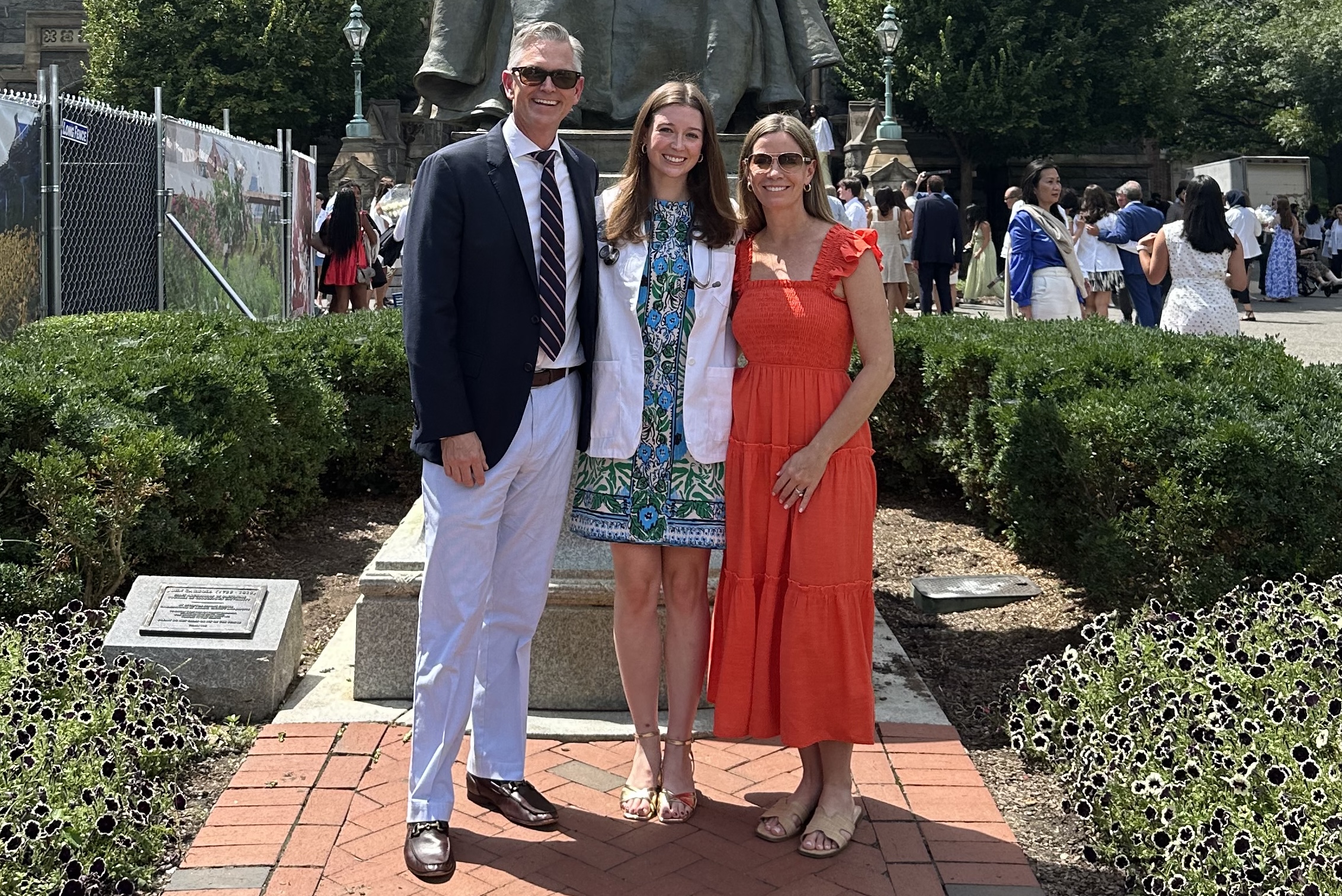
For BellRinger Fellow Meg McCall, medicine is more than a career path—it’s a family legacy. Originally from Glenview, Illinois, just north of Chicago, Meg comes from a long line of physicians. Her father, uncle, and grandfather all practice orthopedic surgery, and her extended family spans several other medical specialties. Though her background offered early exposure to the medical field, Meg is carving her own path, one that began with an undergraduate degree in Science-Business from the University of Notre Dame and now continues at Georgetown University School of Medicine.
Her connection to Georgetown runs deep. Meg was born at MedStar Georgetown University Hospital while her father was completing his residency. Her parents met in the same hospital during their medical training, and her family has remained closely connected to the region ever since. That legacy, coupled with Georgetown’s mission-driven culture and collaborative environment, made it a clear choice for Meg’s medical education. “It just fits my values,” she says. “Georgetown reminds me of what I appreciated most about Notre Dame—people are driven, but grounded in compassion.”
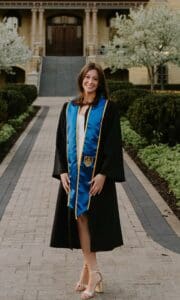 This summer, Meg participated in the Mitchell BellRinger Oncology Research Fellowship Program, joining a team led by Dr. Joyce Slingerland, a professor of oncology at Georgetown’s Lombardi Comprehensive Cancer Center. Meg’s work focused on a retrospective analysis of women with locally advanced breast cancer, using clinical data collected from a safety net hospital in Miami. The study aimed to evaluate how factors such as obesity impact patient outcomes. Meg contributed to the literature review, contextual analysis, and manuscript preparation for publication—helping to highlight how disparities in care and outcomes persist even within specific cancer subtypes.
As someone relatively new to academic research, Meg found the experience both challenging and formative. She credits Dr. Slingerland, a seasoned researcher with decades of experience as a physician-scientist, for guiding her through each phase of the project—from structuring a rigorous literature review to critically evaluating existing data. “This experience gave me a deeper understanding of the research process,” Meg explains. “It reinforced the importance of conducting thoughtful, high-quality research that can meaningfully advance our understanding of cancer.”
While Meg is still exploring future specialties, her interest in oncology has grown throughout the fellowship. She is particularly drawn to fields that allow for longitudinal patient relationships and meaningful continuity of care. “What resonates with me most is the opportunity to build lasting relationships with patients,” she says. “Oncology exemplifies that type of care, and this fellowship helped me see how research and patient impact are deeply connected.”
This fall, Meg will volunteer for BellRinger for the first time. Though she hadn’t participated prior to medical school, she’s looking forward to contributing to the community and experiencing BellRinger Weekend firsthand. “The scale of BellRinger and the spirit behind it are incredible,” she says. “To see survivors and clinicians come together alongside students, families, and friends to raise funds and celebrate progress—it’s inspiring.”
As she continues her training, Meg sees the fellowship and her involvement in BellRinger as important early steps in a long-term commitment to cancer care. “There are so many ways to make a difference,” she says. “Whether through clinical practice, research, or community engagement, this experience reminded me why I chose medicine in the first place.”
The Mitchell BellRinger Oncology Research Fellowship Program, named in honor of Georgetown University School of Medicine Dean Emeritus Stephen Ray Mitchell, MD, recognizes his extraordinary contributions to advancing medical student research during his tenure as Dean for Medical Education at Georgetown. Established in 2024 with support from the family of Elena and Barney Byrd, the program is now additionally funded by Dr. Mitchell and his wife, Ellen, after being deeply moved by the recognition. Through the BellRinger Fellowship program, Georgetown Lombardi will continue to drive cancer research forward and mentor the next generation of researchers.